
The dust has settled, the tow trucks have gone, and you’re holding a small paper with a case number. Weeks later, you receive the full, confusing report of boxes, numbers, and codes—an official timeline of your crash that insurers often use as the final word on fault. But police can make errors in rushing to clear the scene. Knowing how to read these details is crucial for protecting your injury claim.
At the Mike Slocumb Law Firm, we understand that a single checked box can determine whether you get a full settlement or your claim is denied. Our team specializes in analyzing reports, correcting mistakes, and challenging unfair fault assignments.
Police Report Codes: Key Takeaways
Before decoding the specific boxes on your form, here are three critical facts every driver needs to know about their crash report.
- Codes Dictate Fault: Officers use specific numeric police report codes to document factors like speeding or distracted driving. These codes directly impact who the insurance company blames.
- The First Impression: Insurance adjusters frequently assign fault solely on the basis of the “Contributing Circumstances” section. They often do this before speaking to the drivers involved.
- Fixing Mistakes: You can easily correct factual errors, such as incorrect addresses. However, disputing a fault determination requires significant legal intervention and evidence.
Driver and Vehicle Information
This lists insurance, VINs, and contact info. “Unit 1” is typically the at-fault party. Always check the other driver’s insurance code immediately; if it shows a lapse, we need to address Uninsured Motorist (UM) coverage instantly.
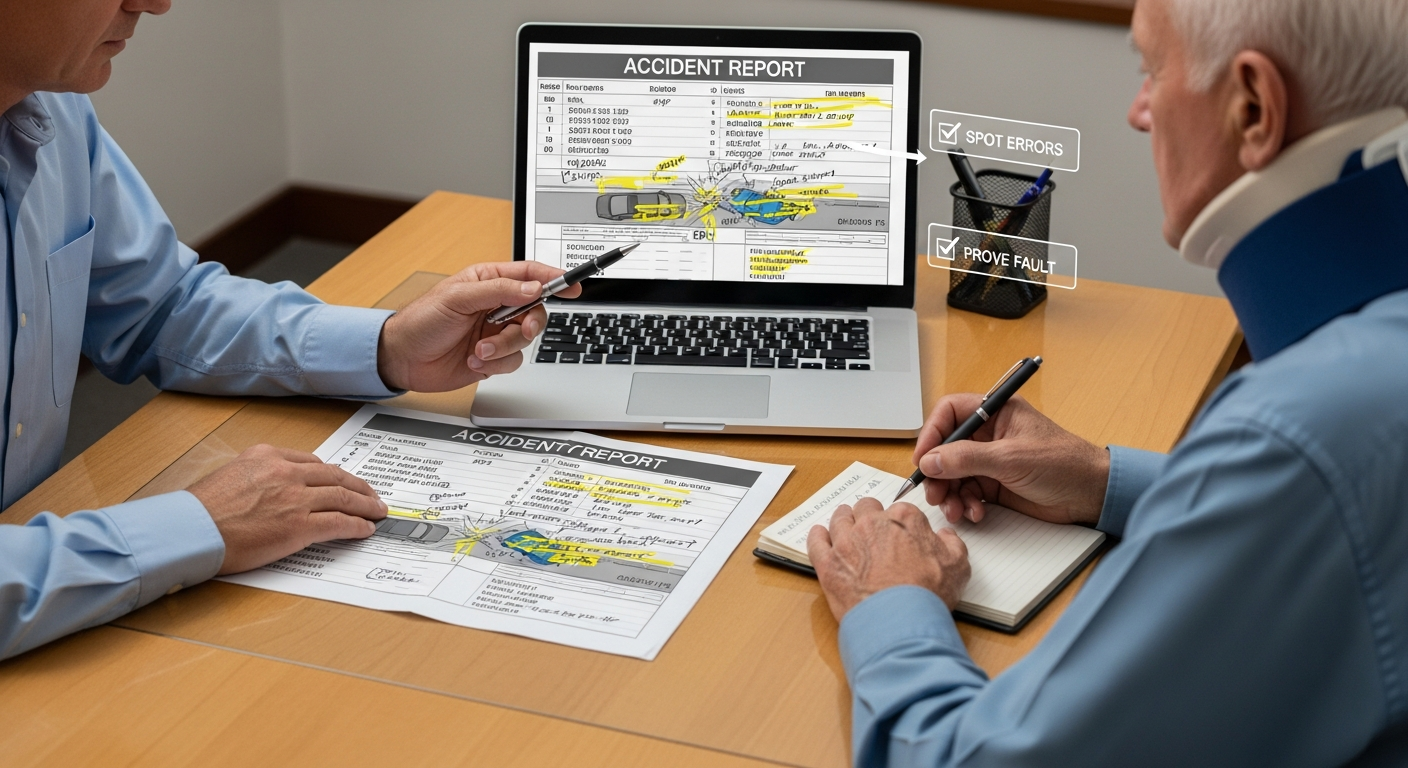
Attorney explains police car accident report codes and liability details to client.
The Narrative and Diagram
The officer’s visual summary often dictates liability. While the NHTSA guides and standardizes these, a flawed diagram (e.g., showing you merging incorrectly) can instantly bias an adjuster. Our attorneys scrutinize these for accuracy.
Interpreting Officer Notes and Codes
The most confusing part of any car accident report guide is deciphering the numeric codes. Officers use these to save space, but they hold massive legal weight.
Deciphering Contributing Factors
Look for a section labeled “Contributing Circumstances” or “Primary Factor.” This is where the officer assigns the cause of the crash.
- Code 01 (No Improper Action): This means the officer does not believe you did anything wrong.
- Adverse Codes: Codes for “Speeding,” “Followed Too Closely,” “Failed to Yield,” or “Distracted” act as a smoking gun for liability. If you see one of these police report codes next to your name, you need legal help immediately.
Understanding Damage Ratings
Officers often rate vehicle damage on a numeric scale.
The “Minor” Trap: An officer might rate your damage as a “1” or “2” even if your frame is bent. The insurance company will use that code to argue the impact was too soft to cause your injuries. We use Body Shop estimates to refute these low damage codes.
Transcription and Administrative Errors
Simple typos, like an incorrect date or VIN, can cause significant headaches or coverage delays. Always verify basic facts immediately.
Omitted Witnesses
Officers frequently focus on drivers and overlook bystanders. If an independent witness isn’t listed, your attorney needs their contact info to save their testimony.
Biased Narratives
If the officer only interviewed the driver who called 911 while you were being treated, the report’s narrative will be inherently biased against you.
Why Accident Reports Are Important for Insurance Claims
For the insurance adjuster, the police report is the first “neutral” piece of evidence. It anchors their investigation.
The Anchor for Liability
According to the National Association of Insurance Commissioners (NAIC), a police report provides an official, unbiased record. This helps expedite the claims process. If the report clearly states the other driver was cited, the adjuster is likely to accept liability quickly.
The Danger of Split Liability
The report might list “Driver Inattention” for both parties. If so, the adjuster will try to split the liability. This can ruin your chance of a full settlement. In many states, partial fault reduces your compensation. We fight to ensure 100% of the blame is placed where it belongs.
How Attorneys Use Reports to Prove Liability
At Mike Slocumb Law Firm, we use the police report as a roadmap, not the final destination. It serves as foundational evidence of liability for the accident that we can build upon.
Impeaching Witness Testimony
The other driver might change their story later. If they claim they didn’t run the light, we use their statement in the police report to prove they are lying. The Cornell Law School Legal Information Institute notes that reports are vital tools in impeachment proceedings.
Reconstructing the Scene
Reports often list details like skid mark length. We use this data to reconstruct the accident with forensic experts. We can prove the other driver was speeding based on the skid marks, even if they denied it.
We also use the report to identify all liable parties. For example, if the report notes the at-fault driver was in a commercial vehicle, we can pursue a claim against their employer. This helps broaden your potential recovery.
Requesting and Amending Your Crash Report
To get your report, you typically request it from the specific police department or a portal like LexisNexis. Small fees usually apply. If you hire our firm, we will handle this administrative task for you.
Fixing Factual Errors vs. Disputing Fault
Simple factual errors, such as an incorrect car color, can be corrected by providing proof to the station. However, disputing at-fault determination, amending a crash report (regarding liability) can be complex. You cannot simply ask an officer to change their conclusion. It requires an attorney to draft formal legal arguments and submit new evidence, such as witness affidavits, to correct the record.
Contact Mike Slocumb Law Firm Today
Don’t let a biased report dictate your claim’s outcome. The police report is robust evidence of liability, but it isn’t infallible. If you struggle to interpret the codes or if the report unfairly blames you, contact our legal team immediately.
At Mike Slocumb Law Firm, we know how to set the record straight. Understanding how to read accident report data is just the first step. When the report is wrong, we fight to make it right.
Car Accident Report Guide: Frequently Asked Questions
Clients often ask our team how this car accident report guide impacts their case.
Is the police report admissible in court?
Generally, no, it is considered “hearsay.” However, officers can testify about it, and it is vital for out-of-court settlements.
What if the police never came?
File a “citizen’s report” with the local DMV or police station to create an official record for your insurance claim.
How long can it take to get the report?
Typically, 3-10 business days. Fatalities or commercial accidents often take longer.
Can I claim injury if it says “No Injury”?
Yes. Adrenaline masks pain. Seek medical attention immediately to link the injury to the crash despite the checkbox.
What if the diagram is wrong?
Rough sketches are common. If the diagram factually misrepresents liability, we will work to amend it.
Our Law Firm information
Mike Slocumb Law Firm is a national personal injury practice dedicated to fighting for the rights of accident victims. We help clients interpret complex liability evidence to maximize their recovery.