
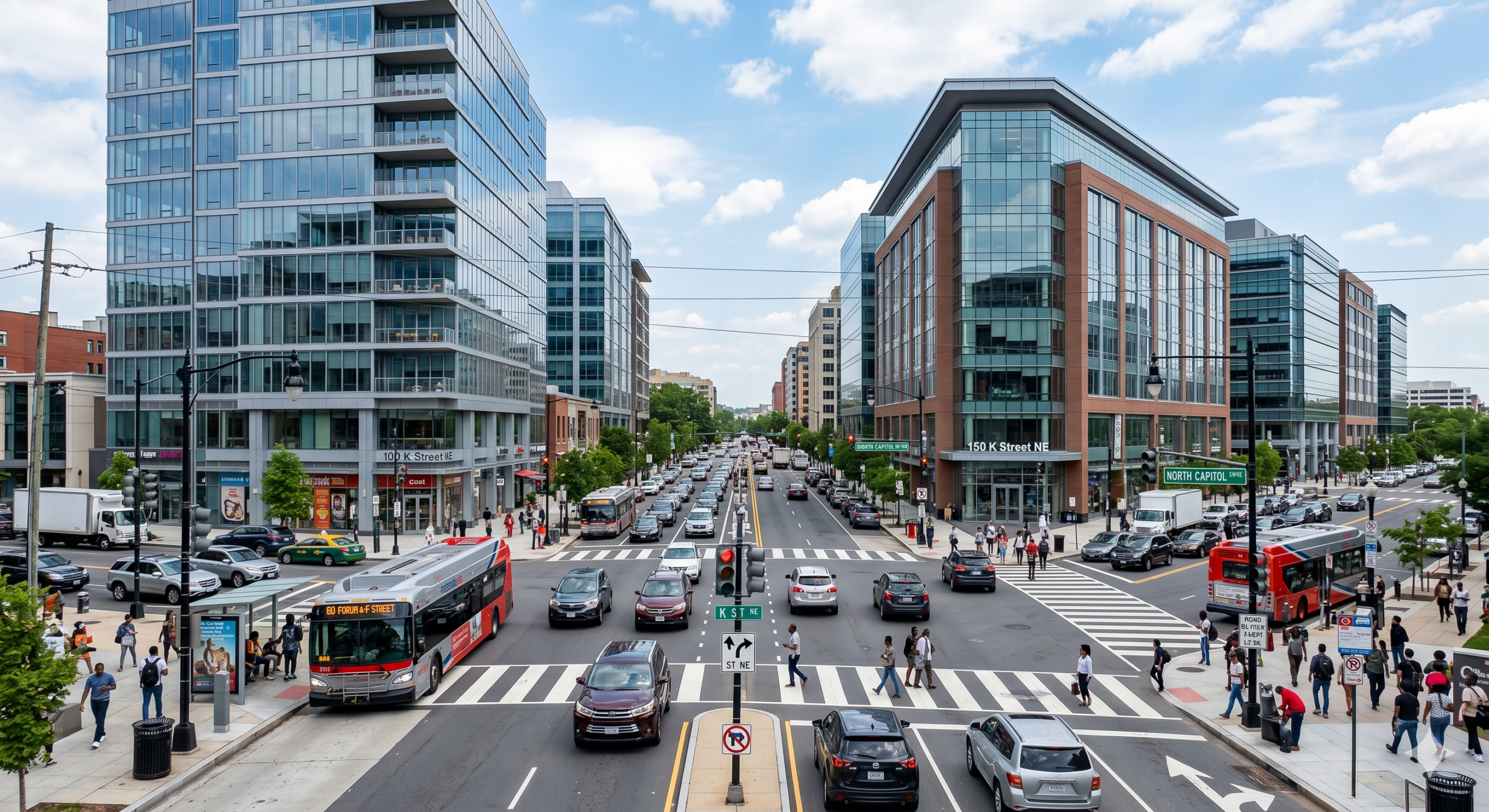
A motorcyclist was critically injured on the afternoon of Saturday, April 12, 2026, after a collision with a car along North Capitol Street near K Street NE, a busy stretch running through Washington D.C.’s NoMa neighborhood.
An accident lawyer knows: for anyone who rides these roads, or a loved one who does, moments like this are a sharp reminder of how quickly things can change.
Details of the Crash at North Capitol and K Street NE
The Incident
Around 3:44 p.m. on Saturday, April 12, 2026, officers from MPD’s Fifth District responded to a collision at North Capitol Street and K Street NE in Northeast Washington’s NoMa neighborhood. The crash involved a car and a Fly Wing motorcycle, according to a report from WJLA 7News.
What Happened
Officers arriving on scene found the Fly Wing rider – a man, unresponsive and suffering from critical injuries. The other vehicle involved remained at the scene, and police were able to speak with that driver.
The Outcome
The motorcyclist was transported to a nearby trauma center for emergency treatment. His condition, beyond being described as critical at the time of initial reports, has not been publicly updated.
Anyone with information about the crash is urged to call the Metropolitan Police Department at 202-727-9099 or text 50411.
Traffic Impact
North Capitol Street serves as one of D.C.’s major north-south corridors, connecting Capitol Hill to the upper Northeast quadrant. A serious collision at this intersection, where NoMa’s dense mix of residential development, commuter traffic, and delivery vehicles converges, inevitably disrupts traffic flow and raises community safety concerns that residents and riders in the area are right to take seriously.
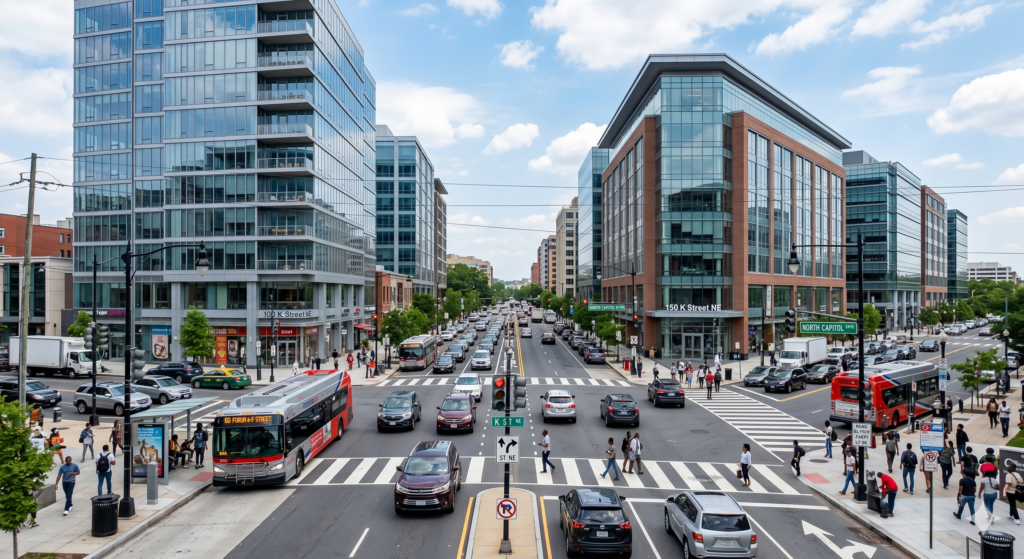
A bustling Washington D.C. intersection with high-rise buildings, traffic, pedestrians, and streetcars under a cloudy sky.
Identifying Legal Rights for D.C. Motorcyclists
When a motorcycle crash happens, one of the first things riders and their families want to know is: what rights do we have? The answer in Washington, D.C., can be more nuanced and more protective than many people expect.
The Right to Answers
Every injured person has the right to understand what caused the crash and who may be responsible.
This includes having evidence preserved, the right to an independent investigation if needed, and the right to speak with a motorcycle accident attorney before making any statements to any insurance company.
D.C. Traffic Laws
D.C. law requires all motorcyclists to hold a valid motorcycle license, maintain proper insurance and registration, obey posted speed limits, use turn signals, and yield to pedestrians. These requirements apply equally to all riders, and understanding them helps clarify whether any party deviated from their legal duty at the time of a crash.
Investigating the “Fly Wing” Bike
The involvement of a Fly Wing motorcycle, a brand producing enclosed, three-wheeled electric motorcycle-style vehicles, may add a layer of complexity to this case. Depending on how the District of Columbia classifies the specific model under its vehicle code (as a motorcycle, motor-driven cycle, or another category), different licensing, registration, and insurance rules could apply. An experienced accident attorney in Washington, DC, would be equipped to examine this classification and its impact on the legal process.
How Liability Is Viewed in D.C. Intersections
Intersection Dangers
Intersections are among the most dangerous locations for motorcyclists anywhere in the country, and D.C. is no exception.
According to data compiled by Vision Zero DC, motorcycle crashes accounted for roughly 18.2% of all traffic fatalities in Washington, D.C. between 2016 and 2020.
Nationwide, the National Highway Traffic Safety Administration (NHTSA) reports that the fatality rate for motorcyclists in 2023 was nearly 28 times that of passenger car occupants.
The Rule of Yielding
At controlled intersections in D.C., drivers making turns, especially left turns, are required to yield to oncoming traffic.
This rule is critically important in motorcycle crash cases. A vehicle making an illegal or careless turn across an oncoming motorcyclist’s path is one of the leading patterns in serious motorcycle collisions.
When a fault is disputed, the sequence of events leading up to impact is examined closely.
Comparative Fault
Here is something many D.C. riders don’t know until they need to: under the Vulnerable User Collision Recovery Amendment Act of 2020, motorcyclists in Washington D.C., are classified as “vulnerable users”. This means they are protected by a modified comparative negligence standard rather than D.C.’s historically strict contributory negligence rule.
In practical terms, an injured motorcyclist may still be able to pursue compensation even if they are found partially at fault as long as their share of fault does not exceed 50%. Each case turns on its own specific facts, and this area of law involves nuances that vary considerably from one situation to the next.
Speaking with a qualified attorney is the appropriate next step for anyone trying to understand how this may apply to their situation.
To better understand the risks, read our guide to the top causes of motorcycle accidents and how to prevent them.
The Investigation Process by the MPD Major Crash Unit
Reconstructing the Scene
Following the April 12 crash, MPD’s Major Crash Unit took over the investigation, a specialized team activated for collisions involving serious injury or death. Their work typically begins with a meticulous reconstruction of the crash scene: documenting skid marks, vehicle positions, road conditions, and physical evidence before the scene is cleared.
Gathering Technical Data
Modern crash investigations go well beyond eyewitness accounts. Investigators may pull data from vehicle event data recorders (EDRs), review traffic camera footage from the District’s network, and examine data from cell phones or navigation systems. In crashes involving electric or tech-enabled vehicles like the Fly Wing, onboard diagnostics may also provide valuable information about speed, braking, and system behavior at the time of impact.
Why Local Knowledge Matters
The NoMa area, bounded roughly by New York Avenue NE to the north, First Street NE to the west, and the rail corridor to the east, has its own traffic patterns, sight-line challenges, and infrastructure characteristics that outside investigators or insurers may not fully appreciate. A Washington, D.C., accident attorney with direct D.C. experience can interpret the Major Crash Unit’s findings in the full context of how that corridor functions and where its recurring hazards lie.
Staying Aware of District Roads
D.C. roads present a unique combination of challenges: dense intersections, rapid development that changes sightlines, federal traffic enforcement zones, and a mix of local, commuter, and tourist drivers who may be unfamiliar with D.C.’s traffic patterns. For motorcyclists, this environment demands heightened awareness at all times.
Some practical reminders for D.C. riders:
- Always assume intersections carry risk. Even on a green light, scan cross traffic before proceeding through.
- Be especially cautious around turning vehicles. Left-turning cars are one of the most consistently documented threats to motorcyclists nationwide.
- Use lane positioning intentionally. Riding in the portion of your lane most visible to other drivers reduces your blind-spot exposure.
- Document everything after a crash. Photographs, witness contact information, and timely medical records are critical to any future legal claim.
The District Department of Transportation (DDOT) continues to implement road safety improvements under its Vision Zero initiative, but riders cannot rely on infrastructure improvements alone for their protection.
Getting Legal Help
If you or a loved one were affected by a crash in the NoMa area, or if you have questions about your rights after a motorcycle accident anywhere in Washington D.C., you don’t have to figure this out alone.
Contact Mike Slocumb Law Firm today for a free, private conversation about your situation and the steps you can take.
There is no pressure and no obligation, just answers from a team that understands what D.C. riders are up against.