
A runaway truck ramp accident is one of the most dangerous crashes on West Virginia’s mountain roads. West Virginia’s interstates weren’t built around the mountains; they were cut through them. Long downhill grades force a loaded truck’s brakes to work for miles at a time, and when a rig loses stopping power mid-descent, a runaway truck ramp may be the only thing between a close call and a fatal crash. In Charleston, where I-64, I-77, and I-79 converge, heavy trucks and everyday commuters share the same corridors. Anyone hurt in one of these crashes faces more than a routine claim, which is why speaking with a West Virginia truck accident attorney early matters.
Why Steep Grades Push Truck Brakes to Their Limit
On a long descent, gravity continuously accelerates a truck. A driver who rides the service brakes instead of downshifting and using engine braking builds friction heat until the brakes fade and stop working. That’s why West Virginia’s steepest interstate grades have mandatory brake-check stops and runaway truck ramps: brake failure on long descents is a recurring pattern, not a rare fluke.
What Typically Sits Behind a “Brake Failure” Finding
A brake failure on a mountain grade is rarely just bad luck. In the Federal Motor Carrier Safety Administration’s (FMCSA) Large Truck Crash Causation Study, brake problems, ranging from outright failure to brakes out of adjustment, were coded for about 29% of the large trucks studied. That made them the most common vehicle-related factor in the study. A few preventable causes sit behind that statistic:
- A missed or rushed DOT inspection that let a worn brake component pass
- Deferred maintenance to keep a truck on a tight schedule
- Brakes improperly adjusted or repaired by a third-party shop
- A carrier culture that puts on-time delivery ahead of safety
Each is a decision made by a person or company, and each can support a negligence claim.
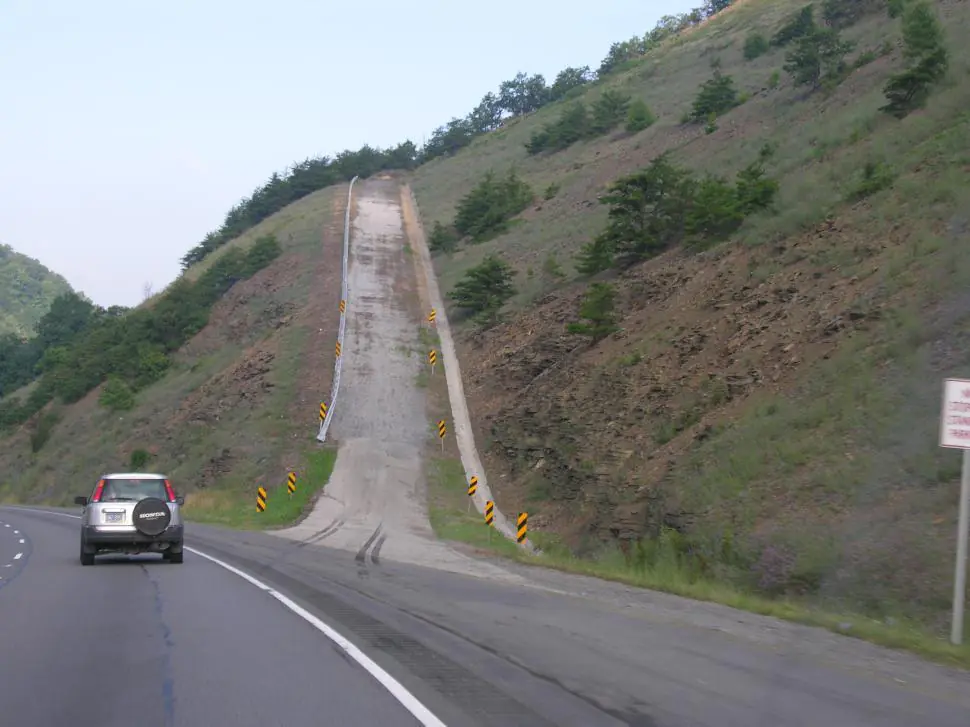
Runaway truck ramp accident prevention: steep uphill escape ramp beside a West Virginia mountain highway
Who Can Be Held Liable in a Runaway Truck Ramp Accident in West Virginia?
Liability rarely falls on the driver alone, so our truck accident attorneys review every party involved. Potentially responsible parties include:
- The truck driver: speeding, skipping a mandatory brake-check stop, or misjudging the grade
- The trucking company: negligent hiring, poor mountain-route training, or scheduling pressure
- A maintenance or repair shop: clearing brakes as road-ready when they weren’t
- A parts manufacturer: a defective brake or steering component
- A cargo loader: unevenly distributed coal, timber, or freight
- A government entity: a poorly maintained ramp or unmarked hazard, in narrower cases
How West Virginia’s Fault Rule Affects Your Recovery
West Virginia follows a modified comparative fault rule. If you’re found more at fault than everyone else combined, you can’t recover anything. If you share some of the blame, your compensation is reduced by your share of fault. Insurers know this, so they work early to build a shared-fault story. That’s why it’s worth calling us before you give any statement to an adjuster.
Why Evidence Needs to Be Preserved Quickly
The truck’s electronic data and the driver’s logs are often the clearest record of what happened on the grade. Federal rules require carriers to keep drivers’ hours-of-service records, including electronic logs, for only a limited time. A formal preservation demand sent early helps keep this evidence from being lost while you focus on treatment, lost income, and recovery.
Frequently Asked Questions About Runaway Truck Ramp Accidents
What makes West Virginia’s mountain highways riskier for trucks?
Long, steep grades and heavy freight traffic push truck braking systems harder than flat interstates do.
Is brake failure a common cause of truck crashes?
More common than most people assume. Federal research found brake problems were coded for about 29% of the large trucks in the crashes studied, more than any other vehicle-related factor.
If I was partly at fault, can I still recover compensation?
Possibly. West Virginia lets you recover as long as you weren’t more at fault than everyone else combined, though your compensation is reduced by your share of fault.
Besides the truck driver, who else might be responsible?
The trucking company, a maintenance provider, a parts manufacturer, a cargo loader, or, in limited cases, a government entity responsible for road or ramp upkeep.
Get Help After a Runaway Truck Ramp Accident
Mountain trucking crashes involve fast-disappearing evidence, multiple potentially responsible parties, and a fault rule that rewards insurers who move quickly to assign blame. At Mike Slocumb Law Firm, we offer a free case review and charge nothing unless we win. Contact us at (304) 802-2115.