
If you or someone you love was hurt on a commercial property, understanding the common locations for slip and fall injuries in downtown Dallas and the legal steps required to prove negligence is vital to securing a fair recovery.
Under Texas premises liability law, property owners do not automatically owe compensation simply because an accident occurred on their premises.
Instead, a successful claim depends on verifying your legal status on the property, establishing the hazard’s physical duration, and proving that management failed to address a known risk.
High-Risk Safety Hazards in Downtown Dallas Districts
Downtown Dallas features a fast-paced mix of high-traffic commercial centers, corporate offices, and hospitality venues.
Slip and fall incidents typically occur due to localized property hazards across major commercial settings:
- Retail Stores and Shopping Centers: Transient hazards such as tracked-in rainwater, leaking refrigeration units, unmopped liquid spills in store aisles, and a failure to place visible cautionary wet-floor signs.
- Restaurants, Cafés, and Dining Venues: Dense seating layouts, slick or greasy kitchen-to-dining entryways, and delayed cleanups of spilled beverages or food debris by staff.
- Office Buildings and Commercial Lobbies: Polished marble or tile floors that become highly slick when foot traffic drags in outdoor rain, especially when property management fails to deploy heavy-duty walking mats at main entrances.
- Parking Garages and Walkways: Structural maintenance failures like cracked concrete pavement, dynamic potholes, hidden loose gravel, and unlit stairwells or walking paths.
Classification of Property Visitors Under Texas Premises Liability Law
To establish a property owner’s legal accountability, Texas common law categorizes injured visitors into three distinct classes.
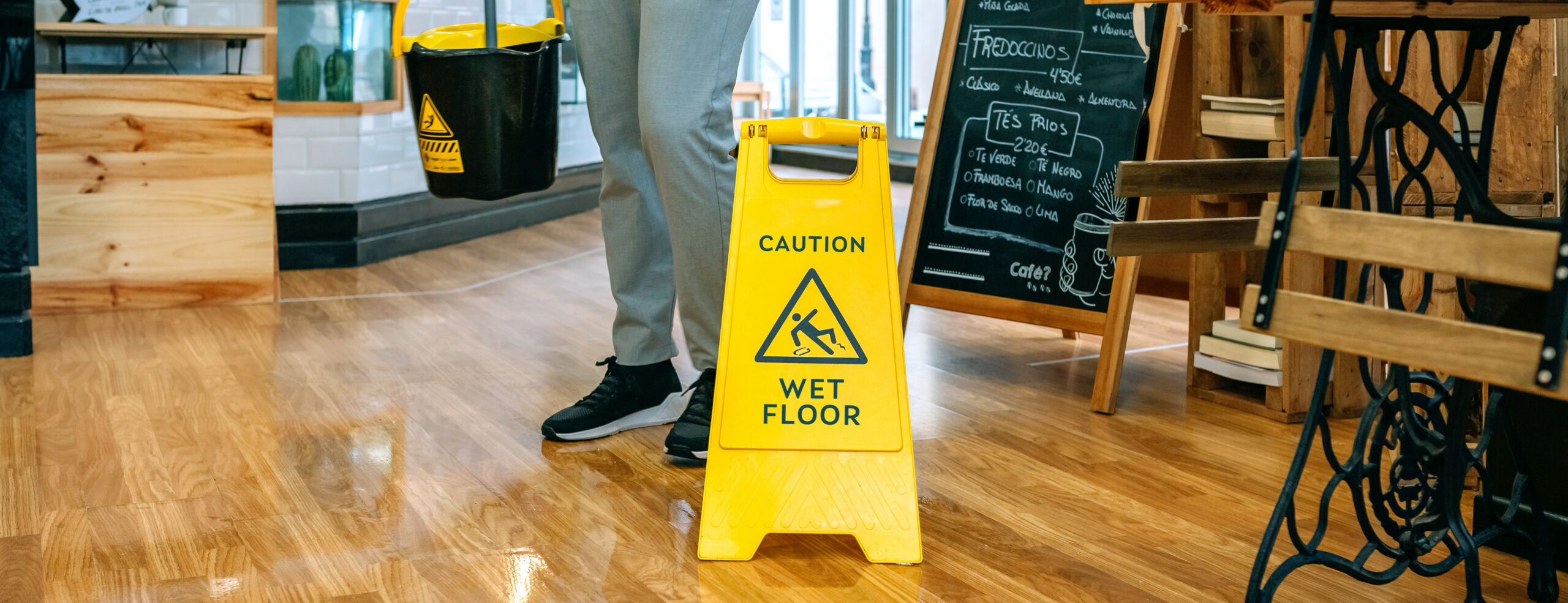
A yellow caution “wet floor” sign in a Dallas cafe highlights property owner liability and premises-negligence safety hazards.
This sorting helps determine the specific baseline duty of care the defendant legally owed you at the moment of your fall:
1. Invitees
An invitee is someone entering a property with the owner’s knowledge for a mutual business or economic benefit. This includes retail shoppers, restaurant diners, hotel guests, and commercial contractors. Property owners owe invitees the absolute highest standard of care and must proactively:
- Exercise ordinary care to maintain the premises in a reasonably safe condition.
- Conduct regular, routine inspections to actively discover hidden structural defects or transient hazards.
- Promptly fix discovered dangers or provide clear, conspicuous warnings about their presence.
2. Licensees
A licensee enters a property with permission but primarily for their own personal convenience or benefit, such as a social guest or a door-to-door courier. For licensees, property owners are required only to warn of dangerous conditions they have actual knowledge of; they are under no legal obligation to inspect the property for hidden structural risks.
3. Trespassers
A trespasser enters a piece of land or a building without any legal right or permission. Landowners owe a minimal duty of care to trespassers, meaning they must only refrain from intentionally or wantonly causing them physical injury.
Proving the Evidentiary Pillars of a Slip and Fall Claim
To successfully recover damages as an invitee in a Texas court, your claim must meet a demanding evidentiary threshold. Per the Texas Supreme Court’s clear premises defect framework, an injured plaintiff must satisfy four core legal elements:
- The property owner or occupier exercised legal control over the premises where the fall occurred.
- A condition on the property posed an unreasonable risk of harm.
- The property owner had actual or constructive knowledge of the condition.
- The property owner failed to exercise reasonable care to reduce or eliminate the risk, thereby directly causing your injuries.
The “Time-Notice Rule” for Constructive Knowledge
Property owners routinely escape liability by claiming they had no idea a slick spill or hazard existed. However, under the Texas time-notice rule, a plaintiff can establish constructive knowledge by demonstrating that the dangerous condition existed on the floor for a sufficient duration of time that a reasonable property owner should have discovered it through ordinary inspection protocols.
As reinforced by the Texas Supreme Court in H-E-B, LP v. Marissa Peterson, circumstantial evidence regarding how a hazard formed is insufficient on its own. Plaintiffs must produce clear temporal evidence detailing the longevity and duration of the danger before the fall occurred to prove that property staff missed a reasonable window of opportunity to clear it.
Preserving Time-Sensitive Digital Evidence
Because property hazards are transient and cleaning crews can wipe away spills or repair structural damage within hours of an incident, early intervention is critical. A dedicated premises liability team immediately issues formal spoliation letters to:
- Freeze and compel the preservation of commercial closed-circuit security camera footage.
- Secure internal corporate incident reports, customer complaint archives, and electronic employee communication logs.
- Subpoena business maintenance schedules, cleaning logs, and third-party facility inspection files.
Navigating Texas Proportionate Responsibility Law
When pursuing financial recovery, insurance adjusters frequently use defense strategies to pivot the blame onto the injured party.
They may assert that you were walking distracted, wearing improper footwear, or entering an area where a hazard was completely open and obvious.
Texas addresses shared fault under a modified comparative negligence system, codified as proportionate responsibility under Texas Civil Practice and Remedies Code section 33.001.
Under this rule, an injured person may recover financial compensation as long as their personal share of fault does not exceed 50%.
If a jury determines that a visitor was partially at fault, the total financial compensation is reduced proportionally.
For example, if your medical bills, lost wages, and pain total $100,000, but a jury determines you were 20% responsible for failing to watch your step, your final legal recovery is adjusted to $80,000.
However, if your fault is determined to be 51% or greater, your right to secure damages is entirely barred under state law.
Additionally, victims must remain mindful of the filing window.
Under Texas Civil Practice and Remedies Code section 16.003, standard personal injury lawsuits must be filed in court within two years from the exact calendar date of the injury.
If this absolute statutory window closes, your right to pursue legal recourse expires completely.
Seeking Legal Help After A Slip or Fall in Dallas
If you are dealing with severe medical expenses or a painful recovery following an incident on a commercial premises in Dallas, you do not have to handle the corporate property managers alone.
Contact the Mike Slocumb Law Firm today to schedule a free, no-obligation case evaluation; or call us directly at 888-302-3669.
Legal Disclaimer
The information provided in this blog post is intended solely for general informational and educational purposes and does not constitute formal legal advice. Accessing, reading, or submitting an inquiry through this content does not establish an attorney-client relationship with Mike Slocumb Law Firm. Every premises liability accident involves highly unique factual circumstances, and municipal codes vary.