
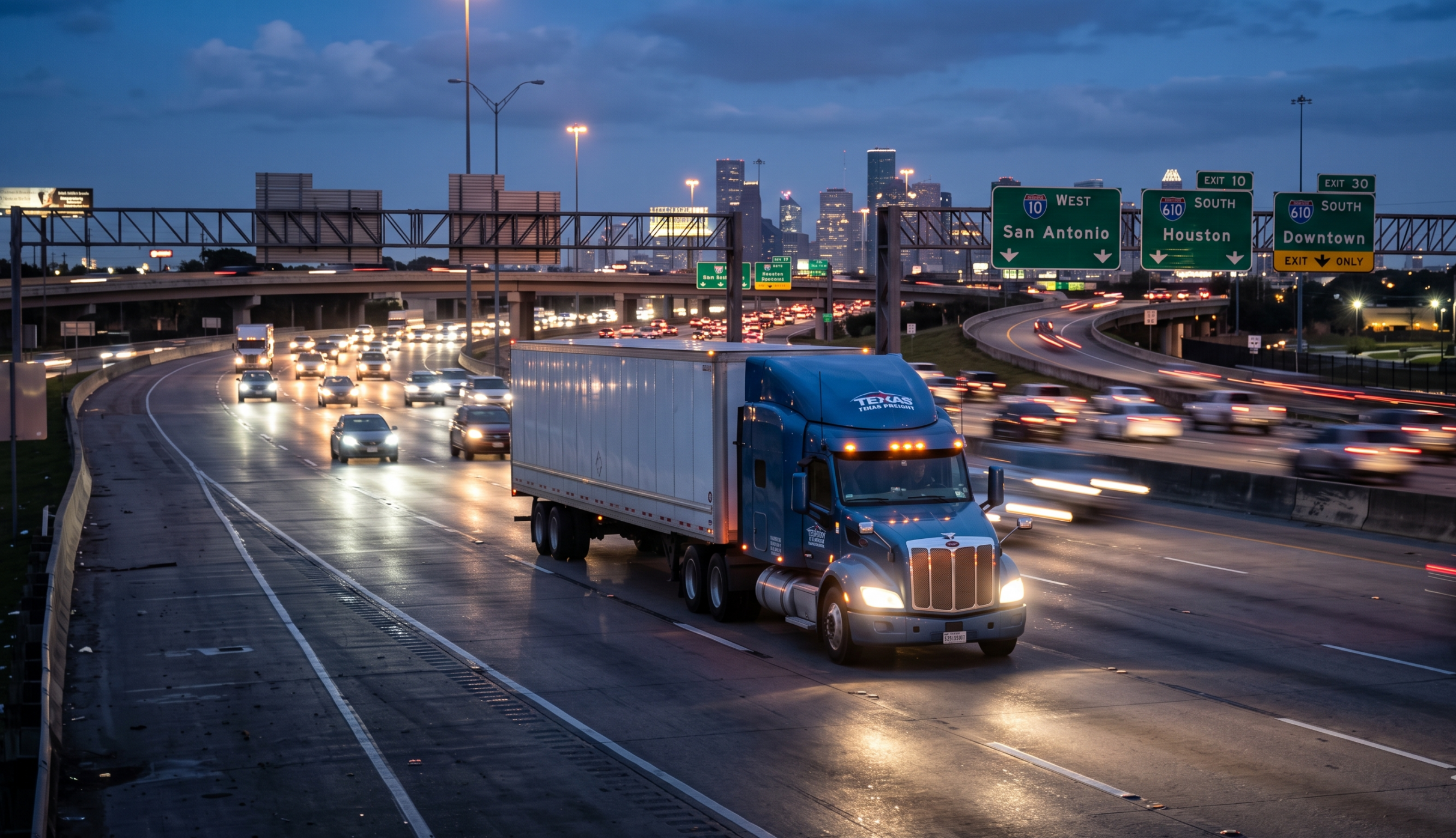
The Bold Win: Data Beats “He Said, She Said” Every Single Time
In most Houston commercial truck crashes, the real fight isn’t your word against the driver’s. It’s objective federal records against a carrier’s insurance team, and when an attorney secures those records before they vanish, the data wins every time.
Why data beats memory in a Texas trucking case:
- Electronic Logging Devices (ELDs) record every hour that a driver spends behind the wheel, including whether they exceeded the federal Hours of Service limits under 49 CFR Part 395. No estimate. No recollection. Timestamped fact.
- Driver Qualification Files (DQFs) document whether the company ran a proper background check before handing over the keys to an 80,000-pound truck. If they skipped it or found red flags and hired anyway, that file proves it.
- Driver Vehicle Inspection Reports (DVIRs) show whether a brake defect, tire warning, or mechanical issue was flagged before that truck ever merged onto I-610 or the Hardy Toll Road. If the carrier knew and kept the truck rolling anyway, the report says so in writing.
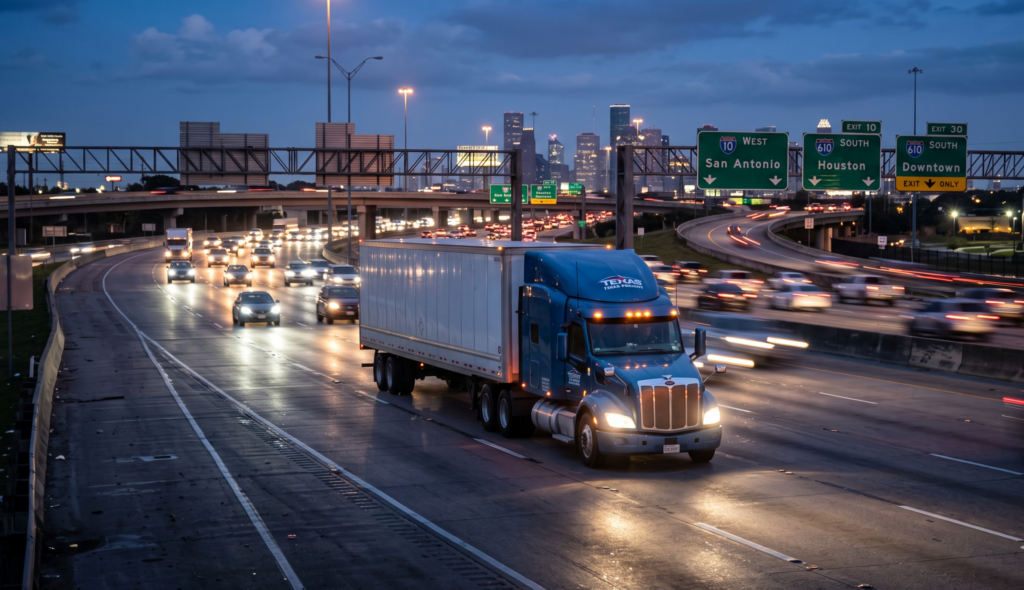
Semi-truck driving on a Houston freeway at dusk with the city skyline
Digital evidence doesn’t fade like human memory. Federal law requires carriers to preserve logs, files, and inspection reports that objectively prove fault. This data transforms roadside disputes into undeniable cases against negligent companies. Since trucking records are often purged within months, acting quickly to secure this documentation is the most critical step for any Houston family.
Our Houston truck accident attorneys at Slocumb Law Firm do one thing before anything else: we send a legal hold notice to the carrier the same day you call us, locking down every record before the clock runs out.
Know the Language Before You Know Your Rights
These four terms will come up in every commercial vehicle case. Here’s what they mean for your family in plain English.
| Legal Term | What It Actually Means for You |
| Respondeat Superior | “Let the boss answer.” If the driver caused harm while doing their job, Texas law makes the employer financially responsible, not just the driver. |
| Vicarious Liability | The company doesn’t have to have directly caused the crash. Their legal relationship with the driver is enough to put them on the hook. |
| Negligent Hiring | The company ran a background check, found red flags, and hired the driver anyway. Or skipped the check entirely to cut costs. Either way, that’s their liability, not yours. |
| Scope of Employment | Was the driver doing their job at the moment of impact? If so, the employer is responsible for it. This is the first question Texas courts ask. |
Why “It Was Just the Driver” Almost Never Holds Up in Texas
The Texas Bar Journal’s analysis of respondeat superior confirms that Texas courts apply a two-step test: first, establish that an employment relationship existed; then, confirm that the driver was acting within the scope of that job when the crash occurred.
If a freight carrier’s driver rear-ends you on the Hardy Toll Road while hauling a load, both boxes are checked before the case even opens.
Where it gets more nuanced: companies routinely label drivers “independent contractors” to sidestep this liability. Texas courts look past the label and examine the reality of who set the routes, who assigned the hours, whose truck was being driven. The Texas Supreme Court in Painter v. American Drilling I, Ltd. confirmed that the right to control an employee’s work, not whether that control was actually exercised, is what triggers employer liability. A driver called a contractor on paper may still make the company fully liable in court.
When the Danger Was Built In Before the Driver Left the Lot
What if the company’s own choices, not just the driver’s actions, caused your crash? That’s direct negligence, and it runs parallel to vicarious liability, not instead of it.
What direct negligence looks like in Houston trucking cases:
- Negligent hiring: Under 49 CFR § 391.51, carriers must maintain complete Driver Qualification Files. The FMCSA’s Pre-Employment Screening Program gives every carrier access to a driver’s five-year crash history before the first mile. Skipping it is a documented, provable choice.
- Negligent retention: Keeping a driver on the payroll after Hours-of-Service violations, failed drug tests, or documented complaints exposes the company to liability for every subsequent crash. FMCSR Part 382 makes drug and alcohol testing an ongoing obligation, not a one-time checkbox.
- Negligent maintenance: Houston’s heat accelerates brake fade and tire failure faster than nearly any other environment in the country. FMCSA requires daily Driver Vehicle Inspection Reports. When carriers defer documented repairs to protect margins, that conduct can trigger exemplary damages under the Texas Civil Practice and Remedies Code Chapter 41.
Direct negligence is not a backup theory. It stands entirely on its own and can be pursued simultaneously with vicarious liability.
Your 3-Step Action Plan: Lock Down the Evidence Before It’s Gone
Per FMCSA carrier retention schedules, some trucking records are legally purged in as little as six months. The carrier’s defense team starts building within hours of a crash. Here’s what you do:
- Photograph everything at the scene. The truck’s DOT number, company name on the cab and trailer, the driver’s credentials, road conditions, your injuries, and every visible vehicle marking. This trail is how we identify every potentially liable party.
- Write down exactly what happened today. Human memory softens and shifts within days. Studies confirm that even honest witnesses reconstruct details unconsciously over time. A timestamped written account of speed, direction, weather, and the precise sequence of events becomes the factual anchor of your case, and it directly counters whatever narrative the insurer tries to build.
- Call a Houston commercial vehicle accident lawyer before you speak to any adjuster. The carrier’s insurer is not your ally. They are specifically trained to minimize your claim from the first call. We sent the legal hold notice that day, locking down ELD data, driver logs, maintenance files, and dispatch records.
Who Else Might Owe You? (The Answer Usually Surprises People)
TxDOT’s 2024 Motor Vehicle Crash Statistics recorded 38,909 commercial motor vehicle crashes in Texas, with Harris County leading every other county in the state. Under 49 CFR Part 387, interstate carriers must carry a minimum of $750,000 in liability insurance, and hazardous materials carriers up to $5 million. Texas law allows you to pursue every responsible party simultaneously.
Beyond the driver and their employer, liable parties can include:
- A freight broker who placed a carrier with a flagged safety record to save money on the load
- A cargo loading company, if improperly secured, could shift or destabilize the truck under 49 CFR Part 393 standards
- A parts manufacturer if a defective component contributed to the crash
- A third-party maintenance shop that signed off on equipment that should have been grounded
Questions Houston Families Ask Us Most
“The company says their driver was an independent contractor. Does that end my case against them?” Not even close. Texas courts examine the actual working relationship of those who controlled routes, hours, and dispatch. The label means far less than the reality. This is our first investigation.
“How long do I actually have to file?” Texas Civil Practice and Remedies Code § 16.003 gives you two years. But given that critical evidence can be legally destroyed in six months, your practical window is far shorter. Call sooner.
“I may have been partly at fault. Can I still recover?” Yes. Texas Civil Practice and Remedies Code § 33.001 allows recovery as long as your share of fault is 50% or less, with the recovery reduced proportionally. Carrier insurers fight hard to inflate your percentage. We fight back with the data they hoped you’d never find.
About Mike Slocumb Law Firm: High-Stakes Injury Law for Houston Families
Mike Slocumb founded our firm to ensure injured families have legal teams that match corporate carriers resource for resource. Having recovered over $500 million nationwide, we bring high-stakes litigation experience to Houston’s commercial corridors. We work on a contingency basis; you owe nothing unless we win your catastrophic accident claim.
Contact Slocumb Law Firm today for your free consultation. No fees. No obligations. Just straight answers from a team that knows exactly what your case is worth and who should answer for it.
Mike Slocumb Law Firm serves injured clients across Houston, Harris County, and the greater Gulf Coast region. Learn more about our firm and our attorneys at our firm overview or explore all practice areas.