
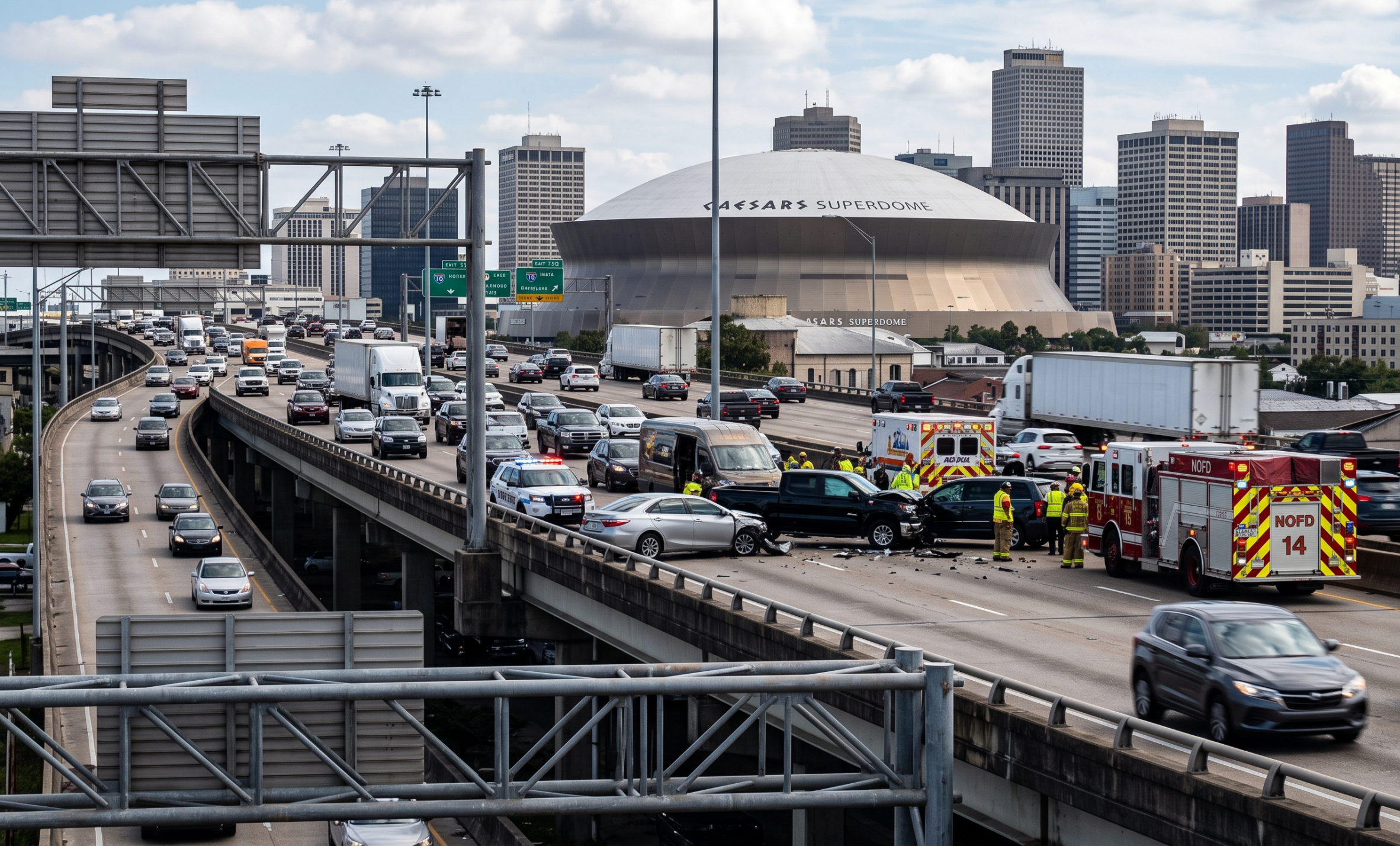
If you drive on I-10 through New Orleans, navigating the Claiborne overpass, merging onto the Pontchartrain Expressway, or threading through the elevated sections near the Superdome, you know every commute carries risk. Orleans Parish recorded 60 traffic fatalities and more than 8,186 suspected injuries in 2024, more fatal crashes than any other parish in the state. Now, Louisiana has fundamentally changed the rules that determine whether you can recover compensation when something goes wrong.
As of January 1, 2026, a new law took effect that every New Orleans driver needs to understand. If you’ve already been hurt in a crash, speaking with a New Orleans car accident lawyer now, before the insurance company locks in a fault narrative, could be the most consequential step you take.
Understanding the 51% Bar Rule under Louisiana House Bill 431
For decades, Louisiana followed a pure comparative fault system. Under the old rule, even if you were 90% responsible for a crash, you could still recover the remaining 10% of your damages. That framework, codified in Louisiana Civil Code Article 2323, is now gone.
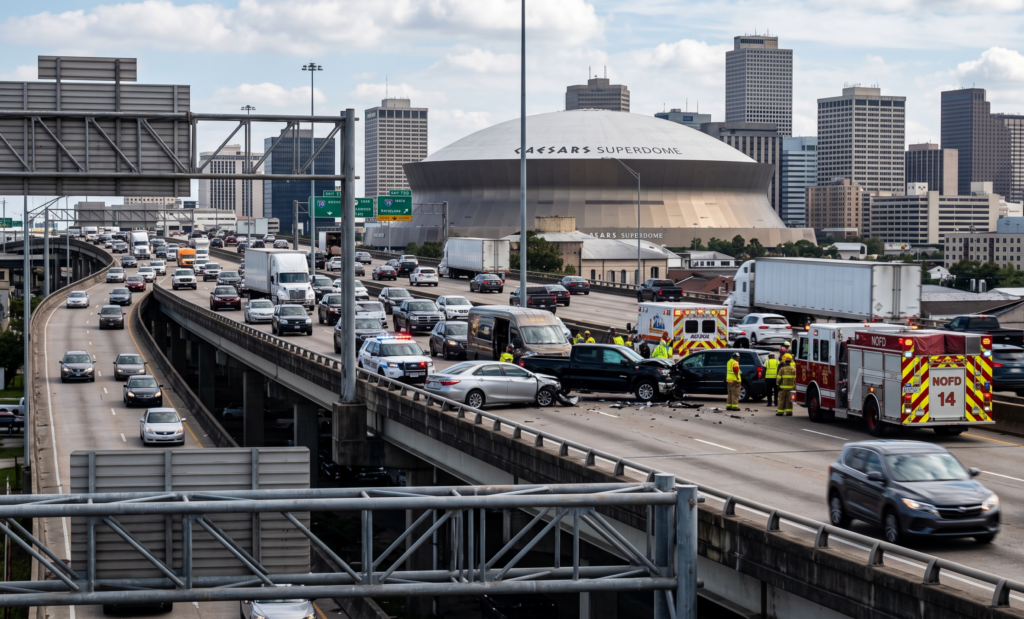
Elevated highway traffic on I-10 in New Orleans near the Claiborne overpass.
Governor Jeff Landry signed House Bill 431 in May 2025, amending Article 2323 and replacing pure comparative fault with a modified system effective January 1, 2026. The rule is straightforward:
- Found 50% or less at fault? You recover damages, reduced proportionally by your share of responsibility.
- Found 51% or more at fault? You are completely barred from recovering anything not a dollar, toward medical bills, lost wages, or pain and suffering.
HB 431 added a critical procedural requirement: in any case where comparative fault goes to a jury, jurors must be explicitly instructed that a plaintiff found 51% or more at fault recovers nothing. Fault arguments are now front and center in every trial.
Why does this hit harder on New Orleans highways? Multi-vehicle crashes on I-10, disputed rear-end collisions on the Lake Pontchartrain Causeway approaches, and high-speed merges near the I-610 interchange all produce murky, contested fault pictures. Insurers can now more credibly refuse payment or significantly reduce settlement offers when fault allocation is ambiguous, knowing a favorable verdict could mean zero payout. The pressure to prove your case clearly and early has never been greater.
How Fault Percentages Determine Your Final Compensation
One percentage point can now mean the difference between a meaningful recovery and nothing at all. Here’s what that looks like in practice:
Scenario A: You’re in a crash on I-10. Total damages: $80,000. The jury finds the other driver 70% at fault, you 30%. You recover $56,000. Your fault share reduced the award, but you still have real compensation.
Scenario B: Same crash, same damages. But the jury finds you 51% at fault, perhaps because your turn signal briefly failed, or a witness account contradicts yours. Under Louisiana Civil Code Article 2323 as amended, you recover $0, even though the other driver was nearly equally responsible. Nothing for medical treatment. Nothing for lost wages. Nothing.
This is the mathematical reality of how Louisiana now distributes compensation. That’s why the evidence gathered immediately after a crash, dashcam footage, witness contacts, skid mark photos, and the police report narrative have become so consequential.
Insurance adjusters are trained to build a record that pushes your fault percentage over 50. A skilled New Orleans highway accident lawyer ensures that the record tells the full, accurate story. Contact the Mike Slocumb Law Firm today for a free case evaluation. The sooner you reach out, the stronger that story can be.
The Two-Year Prescriptive Period for Car Accident Lawsuits (LA Civil Code Art. 3493.1)
Louisiana also changed its filing deadline, called a prescriptive period rather than a statute of limitations. Louisiana Civil Code Article 3493.1 extended the prescriptive period for most personal injury claims, including car accidents, from 1 year to 2 years, effective July 1, 2024, with the prescriptive period running from the date of injury.
Two years gives you more time to treat, stabilize, gather evidence, and weigh your options. But that window closes faster than most people expect. Keep these points in mind:
- The clock starts on the date of the accident, not when you fully understand your injuries.
- Wrongful death claims may carry different timelines. Consult an attorney immediately if you’ve lost a family member.
- Waiting benefits the other side. Witnesses forget. Surveillance footage gets overwritten. Physical evidence disappears. Two years is a ceiling, not a waiting period.
If your accident occurred before July 1, 2024, the old one-year deadline may still apply. A qualified attorney will clarify which rule governs your case at no cost to you.
Consulting a New Orleans Highway Accident Lawyer Early
Louisiana’s legal landscape shifted dramatically in 2026, and insurers were ready long before most drivers knew the rules had changed. On I-10, the Crescent City Connection, and highways across Orleans Parish, a single percentage point of fault can now erase your entire recovery.
The Mike Slocumb Law Firm has spent years helping Louisiana accident victims build airtight fault cases, preserve critical evidence, and counter the narratives insurance adjusters construct to protect their bottom line.
If you were injured on any New Orleans highway, explore our car accident practice to see how we fight for you, then contact us for a free consultation.
Louisiana’s rules changed. Your right to fair compensation has not.