
If you are recovering from a multi-vehicle crash, navigating Olive Branch car accident fault rules on I-22 and Highway 78 can mean the difference between an unfair denial and obtaining full compensation for your injuries.
High-speed corridors such as Interstate 22 and heavily trafficked retail intersections near Goodman Road present unique liability challenges.
Following an accident, insurance adjusters often attempt to deny claims by citing a victim’s minor driving mistakes, but Mississippi statutory law also provides robust protections for individuals who are partially at fault.
Understanding Mississippi’s Pure Comparative Fault System
Mississippi operates under a pure comparative negligence framework governed by Mississippi Code section 11-7-15.
Unlike states with harsh contributory or modified rules where being even partially at fault can entirely block your path to recovery, Mississippi allows injured parties to seek damages regardless of their level of responsibility.
Under this standard, a crash victim’s ultimate financial compensation is systematically reduced by their proven percentage of fault.
For example:
- If a driver is awarded $100,000 in total damages but is found to be 30% at fault for a collision, they remain legally entitled to recover 70% of that award ($70,000).
- Even if an individual is deemed 90% responsible for an incident, they may still seek 10% of their total damages from the other negligent parties.
Because financial outcomes directly mirror these proportions, insurance companies actively focus on artificially inflating your percentage of fault to protect their bottom line.

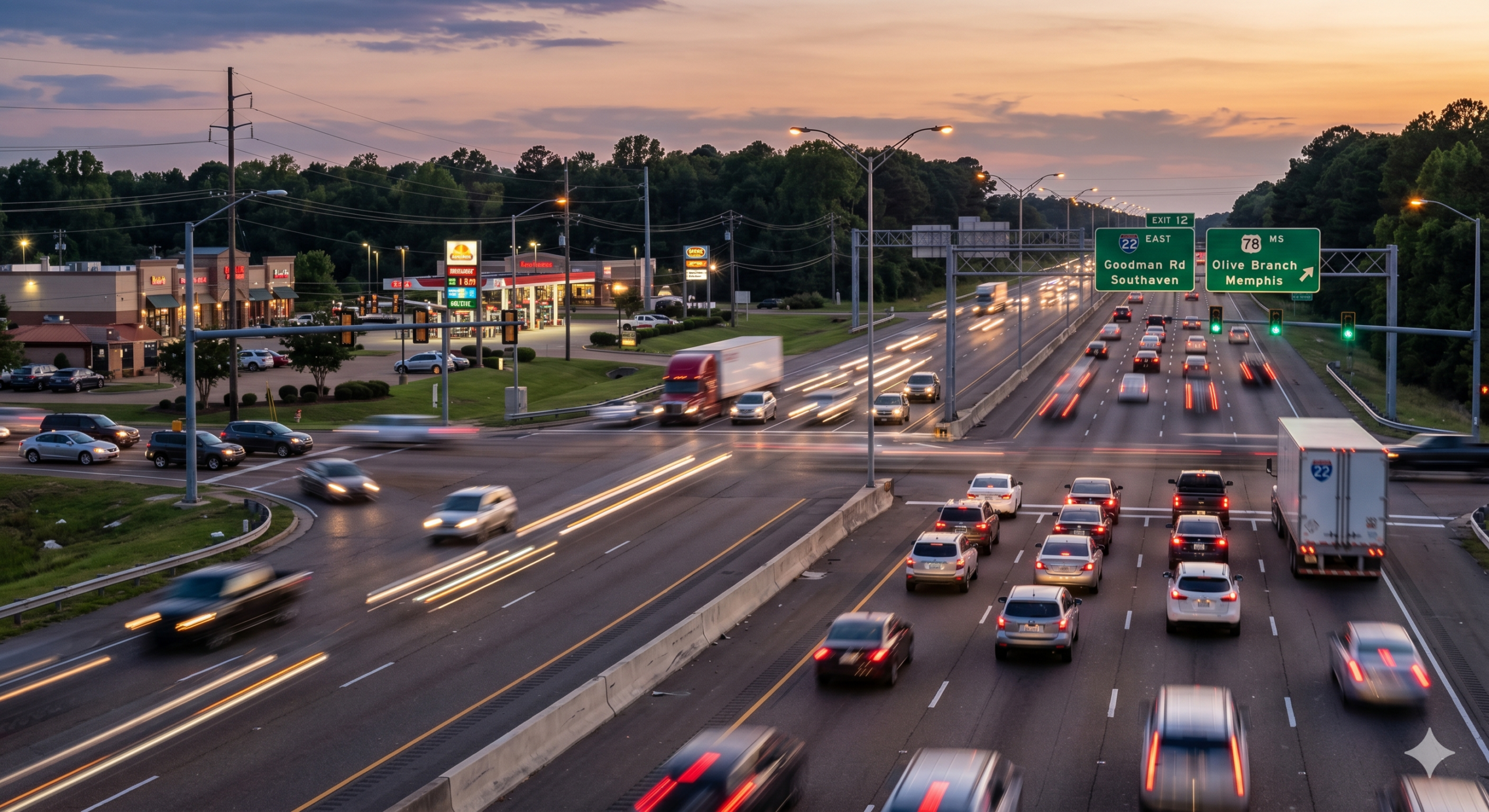
Busy multi-lane I-22 and US-78 highway traffic at dusk in Olive Branch, Mississippi, showing green signs for Goodman Road, Southaven, and Memphis
Local Crash Trajectories: I-22, Highway 78, and Goodman Road
Fault allocation depends on a precise, site-specific investigation.
In DeSoto County, accident dynamics generally shift based on the specific local corridor where the collision occurred:
Interstate 22 (High-Speed Hazards)
With speed limits reaching 70 mph, collisions on I-22 frequently involve severe multi-vehicle chain reactions.
Determining fault on this highway typically involves assessing improper lane merges at access ramps, trailing distances, and whether heavy commercial trucks failed to adjust their braking patterns to rapid weather changes or sudden drops in traffic flow.
Highway 78 and Goodman Road (Intersection Dynamics)
The commercial zones and intersection cross-streets along Highway 78 present completely different liability variables.
Crashes here commonly involve red-light runners, distracted commuters turning into retail centers, or failures to yield the right-of-way.
Fault in these environments is often established by proving that a driver violated localized traffic signals or baseline intersection statutes.
The Complexity of Multi-Vehicle Chain Reactions
When three or more vehicles collide near a major exit, insurance adjusters frequently lean on the “sudden emergency doctrine” or try to pin 100% of the liability on the very first driver who braked.
Under Mississippi law, however, multiple trailing drivers can share fault simultaneously if it is discovered they were tailgating, driving distracted, or failing to maintain functional braking components.
Proving Motor Vehicle Negligence Under Mississippi Law
To build a successful car accident claim in Mississippi, four distinct legal thresholds must be established:
- Duty of Care: The other motorist had a legal obligation to operate their vehicle in a safe, reasonable manner (e.g., matching driving speeds to road conditions, keeping a proper lookout).
- Breach of Duty: The motorist failed to fulfill that obligation (e.g., by texting, tailgating, or speeding).
- Causation: This specific safety breach directly caused the collision.
- Damages: The crash resulted in measurable physical or financial losses (e.g., emergency medical costs, vehicle repair bills, lost wages).
Preserving Decisive Local Evidence
Because Mississippi applies a comparative fault system, a 10% or 20% shift in liability can alter your recovery by tens of thousands of dollars.
Securing maximum compensation requires gathering objective, time-sensitive data before it can be lost or destroyed. Examples include:
- Official Police Accident Reports: Pulling localized accident data through state records or local law enforcement agencies. Learn how to read a Police Accident Report.
- Electronic Logs: Subpoenaing commercial truck “black boxes” (Event Data Recorders) to extract vehicle speeds, steering inputs, and braking timestamps.
- Digital Video: Retrieving third-party business surveillance footage, nearby dashcam recordings, or cell phone connectivity records.
Additionally, victims must remain mindful of the filing window. Under Mississippi Code section 15-1-49, personal injury claims must be filed within a strict three-year statute of limitations.
Waiting too long allows critical evidence to disappear, making it far more difficult to counter aggressive insurance company tactics.
Protecting Your Claim from Common Insurance Tactics
If you are facing the stressful aftermath of a collision on I-22, Highway 78, or anywhere in DeSoto County, you do not have to handle the insurance corporations alone.
Schedule a free, no-obligation case evaluation with Mike Slocumb Law Firm.
Call our team anytime: 888-302-3669.
Legal Disclaimer
The information provided in this blog post is intended solely for general educational and informational purposes and does not constitute formal legal advice. Accessing, reading, or submitting information through this website does not form an attorney-client relationship between the reader and Mike Slocumb Law Firm. Every car accident involves highly unique factual circumstances, and state laws are subject to updates.