
When you enter a grocery store, a friend’s home, or a public park, you have a reasonable expectation that the environment is safe. You shouldn’t have to worry about a collapsing stair or a slick, unmarked spill causing a life-altering injury.
Yet every day, individuals across the country suffer serious harm from hazardous property conditions. According to the National Safety Council, preventable falls remain a leading cause of unintentional death in the United States, with 2024 and 2025 data showing that over 47,000 people die annually from falls in home and community settings.
At Mike Slocumb Law Firm, we know that a “simple fall” is rarely simple. It can lead to broken bones, spinal injuries, or traumatic brain injuries (TBI) that rack up thousands in medical bills. Understanding premises liability negligence is the first step toward securing the compensation you need to recover.
Slip and Fall Negligence: Key Takeaways
- Property Owners Have a Duty: Owners must maintain safe premises for all legal visitors to avoid liability.
- Negligence is the Foundation: You must prove the owner knew, or should have known, about a hazard and failed to fix it.
- Settlement Values Vary: Recent 2026 data shows that settlements often range from $10,000 for minor injuries to over $2.5 million for catastrophic cases.
Duty of Care Explained
In legal terms, “duty of care” is the obligation a property owner has to prevent harm to others. However, this duty isn’t the same for everyone who steps onto the property. Most states categorize visitors into three distinct groups.
Invitees
These are people invited for business purposes, like customers in a retail store or guests at a hotel. Owners owe the highest duty of care to invitees. This includes a legal requirement to conduct regular inspections to identify and fix potential hazards before they cause harm.
Licensees
These are social guests, such as someone visiting a neighbor’s home for a party. The owner must warn them of known dangers. However, owners generally aren’t required to inspect the premises specifically to find new hazards for licensees.
Trespassers
While owners generally don’t owe a duty of care to adult trespassers, they cannot intentionally set traps. Different, stricter rules apply to children under the “attractive nuisance” doctrine. This requires owners to secure hazards, such as swimming pools, that might draw a child onto the land.
Common Hazardous Property Conditions
Negligence often stems from a failure to address preventable dangers. Slip-and-fall attorneys frequently handle cases involving several recurring issues.
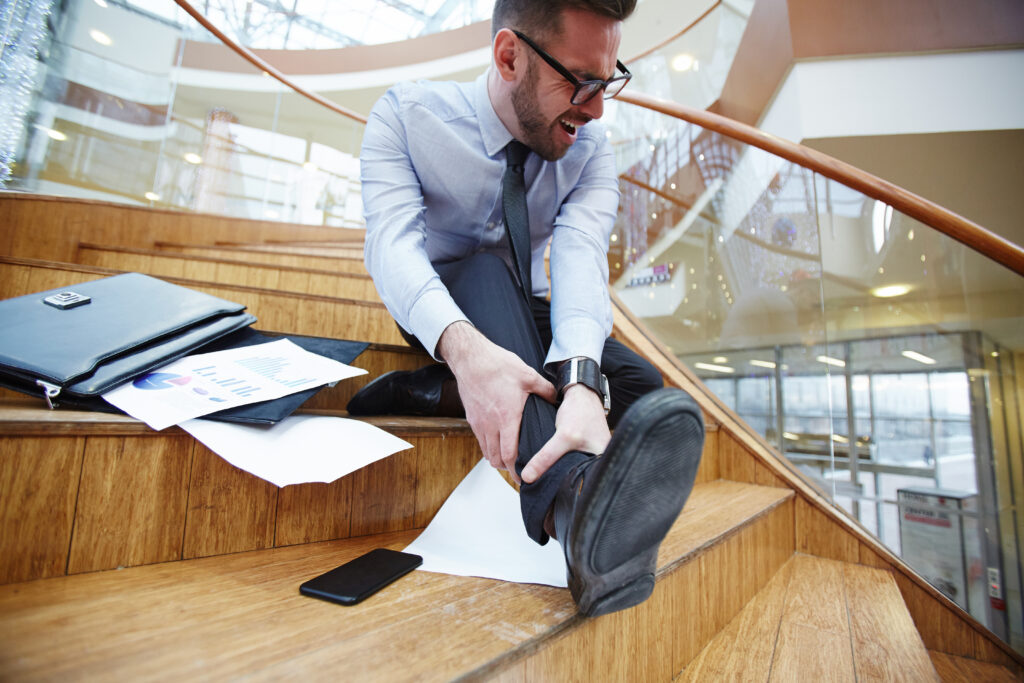
A slip and fall injured man holding his ankle on the staircase inside a commercial building
Slippery surfaces are the most common culprit. This includes liquid spills in grocery aisles, freshly mopped floors without “Wet Floor” signs, and ice accumulation on sidewalks. Poor maintenance is another significant factor. We see many injuries caused by broken handrails, loose floorboards, or crumbling outdoor stairs.
Obstructions and poor lighting also play a major role in premises liability negligence. Cluttered store aisles, loose electrical cords, or dark parking lots hide hazards that a reasonable person could otherwise avoid. Finally, building code violations often form the basis of a strong claim.
Evidence Needed to Prove Negligence
Proving slip and fall negligence requires more than just showing you were hurt. You must demonstrate that the owner’s breach of duty directly caused your injury. Collecting evidence at the scene is critical.
Photos and videos are your best allies. Take high-quality images of the hazard. This includes the spill, the hole, or the ice. Surveillance footage is even more powerful. Retail stores often have cameras that capture the exact moment of the fall and how long the hazard existed before you arrived.
Maintenance logs can show whether the owner performed required safety checks. If a log shows no inspections for six hours before your fall, it supports a claim of constructive notice. Eyewitness statements and your medical records complete the picture by linking your injuries to the date of the accident.
Defenses Property Owners May Raise
Insurance companies and property owners rarely admit fault. They often use specific legal defenses to reduce or eliminate your compensation.
The “Open and Obvious” defense is common. They argue the hazard was so visible that any reasonable person would have seen and avoided it. If you were looking at your phone when you fell, they will likely use this against you.
State laws on fault are also a major factor. In Alabama, if you are found even 1% at fault, you may be completely barred from recovery under the pure contributory negligence rule. In Georgia, under OCGA Section 51-12-33, your compensation is reduced by your percentage of fault. If you are 50% or more responsible in Georgia, you recover nothing.
Case Examples of Premises Liability Claims
- The Unmarked Spill: A customer at a big-box store slips on a leaking bottle of detergent. Because the detergent was dirty and had tracks through it, a jury may find the store had “constructive notice.”
- The Broken Handrail: A tenant falls down a dark apartment stairwell because a handrail gave way. If the tenant had previously complained in writing about the loose rail, the landlord has “actual notice.”
- Negligent Security: A patron is assaulted in a dark parking lot of a mall that has a history of crime but no security guards. The mall may be held liable for failing to provide adequate protection.
Data-Driven Insights: 2026 Settlement Trends
Recent legal industry analysis shows that the severity of the injury and the strength of evidence are the primary drivers of compensation.
| Injury Category | Average Settlement Range (2025/2026) | Typical Legal Action |
| Minor Soft Tissue | $10,000 – $50,000 | Insurance Settlement |
| Surgical Fractures | $100,000 – $500,000 | Litigation / Settlement |
| Traumatic Brain Injury | $500,000 – $2,000,000+ | Jury Trial / Mediation |
| Spinal Cord Injuries | $1,500,000 – $5,000,000+ | Jury Trial |
Contact a Premises Liability Lawyer Today
Don’t let a property owner’s negligence derail your life. If you’ve been injured, our team is ready to review your case for free.
Contact Mike Slocumb Law Firm today for a free virtual consultation, or call 888-302-3669.
Ensure your rights are protected and that all critical evidence is preserved before it is gone.
Premises Liability Negligence: Bottom Line
Proving negligence in a property accident is a race against time. Evidence like surveillance footage and maintenance logs can disappear within days of an incident. By working with an experienced firm, you ensure that the facts are preserved and the property owner is held accountable for their breach of duty.
Premises Liability Negligence: FAQ
What counts as premises liability negligence in a legal claim?
Negligence occurs when a property owner fails to fix or warn about a hazard they knew about or should have discovered. This breach must directly cause your injury.
How long do I have to file a claim in Georgia or Alabama?
In both states, you typically have two years from the date of the injury to file. Missing this deadline usually means you lose your right to recover compensation.
Can I sue if I was injured at a friend’s house?
Yes, though the claim is usually filed against their homeowners’ insurance policy. The goal is to cover your medical expenses through existing insurance coverage.
What if there were a “Caution” sign present?
A sign is a defense for the owner, but it is not an absolute win. If the sign was placed poorly or the hazard was still unreasonably dangerous, you may still have a valid claim.
Do I need an attorney for a minor’s slip-and-fall?
While not required, data shows that represented claimants secure significantly higher settlements. Attorneys can subpoena private security footage and maintenance records that you cannot access alone.
About Our Law Firm
Mike Slocumb Law Firm is a premier personal injury firm dedicated to representing victims of negligence. Known as “The Hammer,” Mike Slocumb and his team have recovered over $500 million for clients across the country from offices in Auburn, Birmingham, Washington D.C., Baltimore, and beyond. Learn more about our mission on our About Us page.