
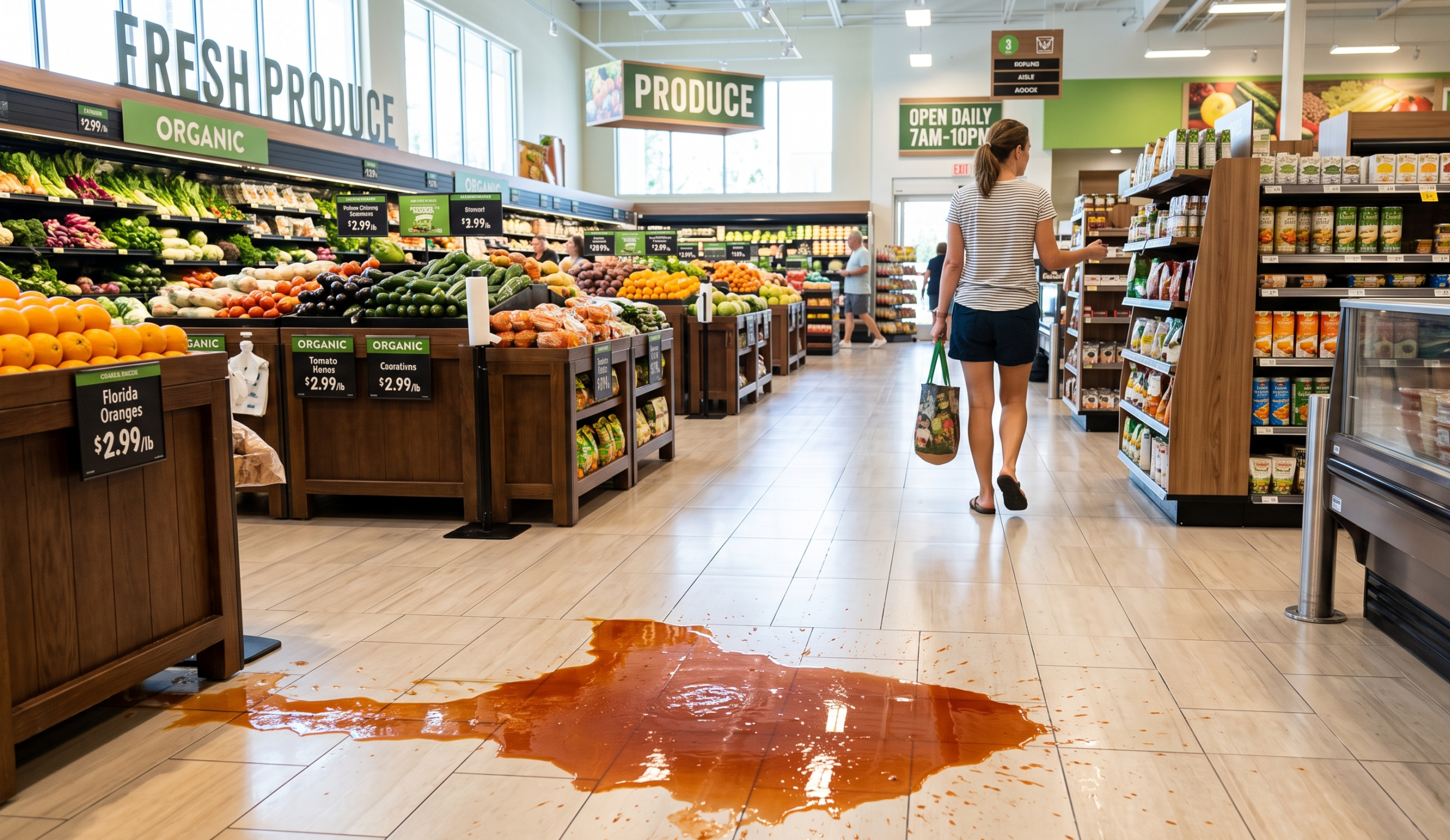
You slipped and fell at a Fort Lauderdale grocery store, causing injury and pain. While your instinct is to blame yourself, remember that the store might be legally responsible for your injuries, and Florida law gives you specific tools to prove it.
The difference between winning and losing your slip and fall case in South Florida comes down to one critical legal concept: constructive knowledge. This isn’t just legal jargon; it’s the bridge between your injury and the business owner’s responsibility. And it all hinges on understanding Florida Statute § 768.0755.
If you’ve been injured in a slip and fall in Fort Lauderdale, our team of Fort Lauderdale slip and fall lawyers understands exactly how to build your case. But first, let’s walk through the legal framework that governs your claim.
The Burden of Proving Constructive Knowledge in Florida (FL Statute § 768.0755)
Under Florida law, if you slip and fall on what’s called a “transitory foreign substance” (think spilled juice, oil, water, or debris) in a business, you must prove two things:
- The business had actual or constructive knowledge of the dangerous condition
- The business should have taken action to fix or warn about it
The second part is straightforward. But that first part, constructive knowledge, is where many Fort Lauderdale injury victims stumble.
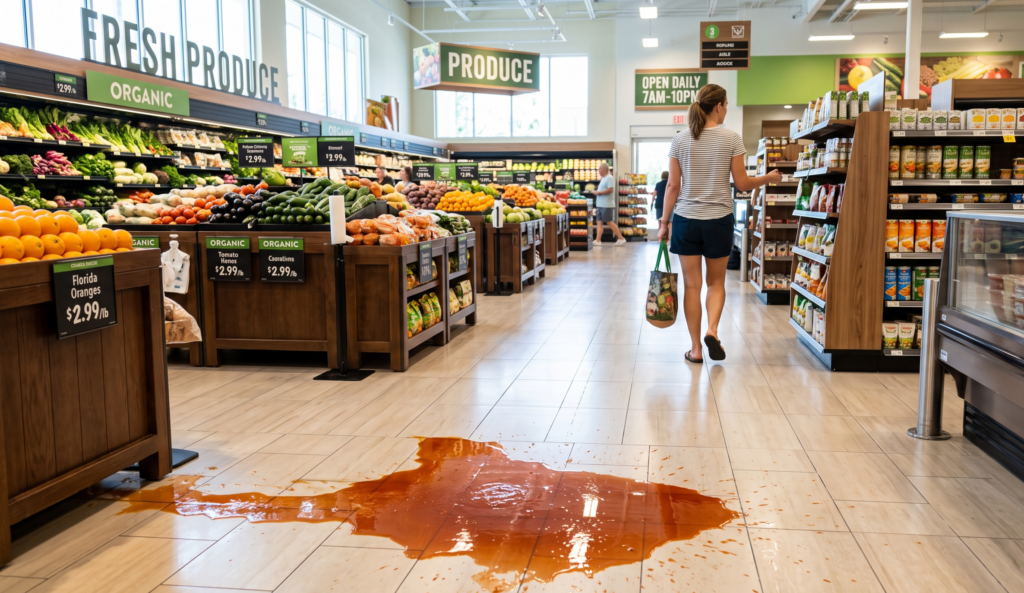
A foreign substance was spilled on a supermarket floor, creating a dangerous slip-and-fall hazard for shoppers.
Constructive knowledge doesn’t mean the store manager saw the spill. It means the condition existed long enough or occurred frequently enough that the business should have known about it through ordinary care and routine inspection.
Under Section 768.0755(1), Florida law provides two ways to establish constructive knowledge. First, you can show that the dangerous condition existed long enough that the business, exercising ordinary care, should have discovered it. Second, you can demonstrate that the condition occurred regularly and was therefore foreseeable. This principle was clarified in the landmark case Owens v. Publix Supermarkets (2001), in which Florida’s Supreme Court established the baseline for premises liability.
Here’s why this matters in Fort Lauderdale specifically: Our bustling downtown retail corridors, beachfront hotels, and high-traffic restaurants see hundreds of visitors daily. When a business invites that kind of foot traffic, they also accept the responsibility to inspect its premises regularly. A spill in a Broward County shopping center isn’t the same as a spill in a quiet corner of someone’s home.
What Counts as “Long Enough”?
Florida courts don’t use a stopwatch. Instead, they ask: What would a reasonable business owner discover during normal operations?
Courts evaluate how long a substance has been on a floor by examining footprints, track marks, changes in consistency, or drying. Dirty puddles with shoe marks suggest a meaningful time period, not seconds. This Florida appellate standard uses the “plus factor” test: a substance on the ground plus additional facts showing it existed long enough for discovery. In a real scenario, juice that’s discolored and walked through multiple times becomes evidence; the puddle’s appearance, not the store’s admission, tells the story. Document the hazard immediately: photograph it from multiple angles, note the time, and request maintenance logs. This evidence collectively proves the business knew or should have known of the danger.
Proving a Transitory Foreign Substance Caused Your Injury
You need to be crystal clear on this point: A “transitory foreign substance” refers to any temporary, unnatural, or unexpected substance on a surface that can cause a slip, trip, or fall. This includes liquids such as water or oil, solid items such as food or debris, or any other substance that isn’t normally present and could create a hazardous condition on a floor, walkway, or other surfaces.
Fort Lauderdale businesses encounter these hazards constantly:
- Rainwater tracked inside during Florida’s afternoon thunderstorms
- Beverage spills at restaurants, bars, and cafés along Las Olas Boulevard
- Produce debris at grocery stores and farmers’ markets
- Gasoline pooling in gas station parking lots
- Ice accumulation (rare, but it happens during cold snaps)
- Grease and food particles in commercial kitchen areas
The key is proving the substance was foreign, meaning it didn’t belong there. A coffee stain on a coffee shop floor is expected; motor oil in a convenience store is not.
Proving it caused YOUR specific fall requires medical evidence. Your doctor must document that you fell due to a slippery surface, not carelessness. Seek immediate medical attention and contact our Fort Lauderdale team immediately to preserve evidence and protect your claim.
The Role of Surveillance Footage and Maintenance Logs
Surveillance footage is the gold standard of evidence for proving constructive knowledge. A camera shows exactly how long the substance remained, whether employees ignored it, and when it was cleaned, providing objective proof the business knew or should have known.
Critical timing issue: Most retail systems overwrite footage every 24–72 hours. Act immediately after a fall. When Mike Slocumb Law Firm takes a case, we subpoena:
- Surveillance from the 24–48 hours surrounding the incident
- Maintenance and cleaning schedules
- Employee shift reports and prior incident records
- Weather reports
In humid Fort Lauderdale, businesses near beaches or leak-prone areas have a higher duty to manage moisture. Obvious hazards strengthen your constructive knowledge claim.
Why You Need a Fort Lauderdale Slip and Fall Lawyer
Businesses rely on intimidation to force low settlements. Florida Statute § 768.0755 reintroduced strict notice requirements, absent since 2001, mandating you prove the owner knew or should have known of the danger. This higher burden makes legal representation essential.
Our experienced attorneys:
Investigate immediately, photographing scenes, interviewing witnesses while memories are fresh, and preserving evidence before it disappears.
Build the “plus factor” argument, combining testimony, footprints, drying patterns, and maintenance schedules into compelling narratives that defeat summary judgment motions.
Navigate comparative negligence, countering business claims of your carelessness with evidence of the hazard’s obviousness.
Calculate actual damages, documenting medical costs, lost wages, and pain and suffering.
Negotiate settlements, knowing when to hold firm or push toward trial.
Act now. Evidence and witness memories fade quickly.
Contact Mike Slocumb Law Firm for a free consultation. Our experienced Fort Lauderdale attorneys will investigate your claim and fight for your rights. This first step is free and can change everything.
Related Resources
Explore our practice areas or learn more about our firm’s premises liability practice.
If you’ve been injured in a slip and fall, don’t wait. Evidence disappears. Witnesses move away. Your story becomes harder to tell the further removed you are from the incident.
Contact Mike Slocumb Law Firm for a free consultation. Our Fort Lauderdale slip-and-fall attorneys have decades of experience fighting for injured people just like you. We’ll investigate your case, explain your rights under Florida law, and fight to get you the compensation you deserve.
The first step costs you nothing. The conversation could change everything.
For more information about premises liability and your rights as an injured person on someone else’s property, explore our practice areas or learn more about our firm.